Kansas City’s Most Comfortable Mammogram

Clarity Care offers Kansas City’s most comfortable mammogram and advanced 3D technology, paired with expert radiologists to provide comprehensive breast cancer screening and early detection services. Annual screening mammograms are covered by insurance at 100% and recommended for women 40+, earlier for women at a higher risk.
What is a mammogram?
A mammogram is a specialized medical imaging test that uses low-dose X-rays to examine the breasts. The primary purpose of a mammogram is to detect early signs of breast cancer, often before any symptoms are noticeable. This test is capable of identifying various changes in breast tissue, including unusual growths and areas of abnormal density that might indicate the presence of cancer.
Breast Imaging and Mammograms: Step by Step
1.
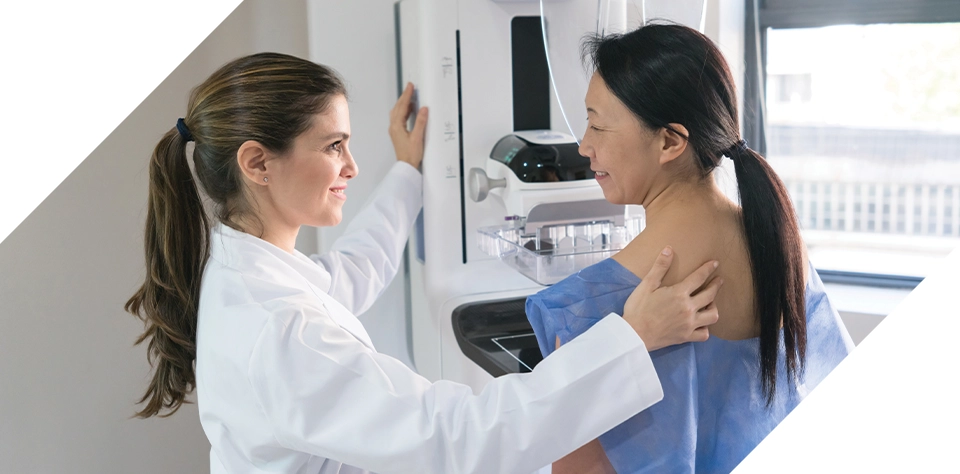
During a mammogram, you will stand in front of a specialized mammography machine, and a technologist will position your breasts for the x-ray.
2.
The breast is gently compressed with our advanced Comfort Paddle technology. The unique design adapts to the natural shape of the patient’s breast, providing a gentler and more personalized compression. This ensures a better experience while delivering the high-quality imaging you deserve.
3.
The breast is gently compressed with a paddle to even out the breast thickness and ensure clear images.
4.
Low-dose X-rays are employed to take images of the breast from various angles, searching for any abnormal areas that could suggest the presence of cancer.
5.
Images are then sent to and reviewed by our expert radiologists, who are trained to identify signs of breast cancer. Additional images or ultrasound might be suggested based on initial findings.
6.
We review your mammogram images and take any extra views while you’re here. Our radiologist will discuss the results with you before you leave, giving you immediate clarity and reassurance.
Breast Imaging and Mammogram FAQ
Mammograms are crucial for:
- Regular screening: Recommended annually for women over 40 or earlier for those at higher risk.
- Diagnosis and monitoring: If there are symptoms such as a lump, pain, or nipple discharge.
- Follow-up checks: Post-procedure monitoring to ensure no recurrence of breast cancer.
During a mammogram, here’s what you can generally expect:
- Preparation: Upon arriving, you’ll change into a hospital gown and should avoid wearing deodorants or perfumes as they can interfere with the images.
- Positioning: You’ll stand by the mammography machine, where a technologist will position your breast on a platform and gently compress it with another plate from above for a few seconds. This is repeated from different angles and for both breasts.
- Imaging: The actual imaging takes just a few minutes. You might need to change positions to capture different views.
- Compression: Compression is brief and necessary for clear images, but our curved paddle technology minimizes the discomfort.
- Duration: The entire procedure typically takes about 20 minutes.
After the scan: You can immediately resume normal activities. - You may access imaging reports in our imaging patient portal.
A mammogram can be a bit uncomfortable, especially during compression, but it’s a fast and essential procedure for monitoring breast health and early detection of breast cancer. Scheduling a mammogram for the week after your menstrual period when breasts are less likely to be tender, can help reduce discomfort.
Experience a more comfortable mammogram with our advanced comfort paddle technology, designed to reduce discomfort without compromising accuracy. The unique design adapts to the natural shape of the breast, providing a gentler and more personalized compression. This ensures a better experience while delivering the high-quality imaging you deserve.
- Mortality Reduction: Mammography can decrease breast cancer mortality by 20-40% among women aged 40 to 74.
- Early Detection: Mammograms can identify tumors up to two years before they can be felt, increasing procedure options.
- Breast Density Impact: Women with dense breasts are up to five times more likely to develop breast cancer, and mammograms are essential for determining breast density.
- Family History Factor: Women with a family history of breast cancer may need to begin mammograms earlier due to increased risk. Notably, 75% of women diagnosed with breast cancer have no family history of the disease.
- Age: The risk of breast cancer increases with age. Most breast cancers are diagnosed after age 50.
- Genetic Factors: About 5-10% of breast cancer cases are thought to be hereditary, primarily caused by abnormal genes passed from parent to child. The most common are mutations in the BRCA1 and BRCA2 genes.
- Family History: Having a first-degree relative (mother, sister, or daughter) with breast cancer nearly doubles a woman’s risk. Having two first-degree relatives increases the risk even further.
- Personal History of Breast Cancer or Certain Non-Cancerous Breast Diseases: Women who have had breast cancer are more likely to have it again. Certain non-cancerous breast conditions, such as atypical hyperplasia, also increase the risk.
- Breast Density: Women with dense breasts are more likely to develop breast cancer and have more difficulty detecting tumors via mammograms due to dense tissue obscuring the cancer.
- Reproductive History: Early menstrual periods (before age 12), late menopause (after age 55), having your first child at an older age, or never having given birth can all increase breast cancer risk.
- Radiation Exposure: Women who have received radiation therapy to the chest or breasts (like for procedure of Hodgkin’s lymphoma) before age 30 have a higher risk of developing breast cancer later in life.
- Lifestyle Factors: Lack of physical activity, poor diet, being overweight or obese, and excessive alcohol consumption can increase breast cancer risk.
- Hormone Replacement Therapy (HRT): Long-term use of hormone replacement therapy (estrogen-progesterone combinations) for menopause symptoms increases the risk.
- Sensitive and respectful care: Our staff is trained to provide a comfortable and respectful experience.
- KC’s most comfortable mammogram: Experience a more comfortable mammogram with our advanced comfort paddle technology, designed to reduce discomfort without compromising accuracy.
- State-of-the-art technology: We offer 3D mammograms, or tomosynthesis, the latest technology for high-quality images for accurate diagnosis.
- Expert radiologists: Our specialists are skilled in detecting the earliest signs of breast cancer.
For most women, screening mammograms are covered by health insurance without copays or deductibles. However, diagnostic mammograms, which are conducted when there is a suspected problem, might require a copay or be subject to a deductible.
At Clarity Care, we aim to make your experience as transparent and easy as possible. That’s why we offer both standard prices for those with insurance and cash prices for those without insurance.
Download Clarity Care Mammogram Pricing »
No insurance? Don’t worry! If you’re a Kansas resident we can assist with enrollment in the Early Detection Works program, which may pay for your mammogram as well as related follow up care.
Clarity Care Imaging & Specialty Care is at 9040 Quivira Road in Lenexa, Kansas. Our center is conveniently located just north of Oak Park Mall with easy access from much of the Kansas City area including Overland Park, Olathe, Shawnee, Merriam, Mission, Leawood and Prairie Village.
A doctor’s order is not required for a screening mammogram, but if you have a primary care doctor we will share your result with them unless you request us not to. If you don’t have a primary care doctor, you can still get a screening mammogram, and we can assist with referrals for any necessary follow up.
Why Choose Clarity Care?
- Experience the Most Comfortable Mammogram in KC
- Fast results. Get your results before you leave! If follow up imaging is required, we can usually do it immediately to minimize stressful waiting.
- No out of pocket costs for recommended screening mammograms with most insurance.
- Coverage for no insurance. If you’re a Kansas resident we can assist with enrollment in the Early Detection Works program, which may pay for your mammogram as well as related follow up care.
- The latest 3D technology, with advanced AI-enabled detection
- A comfortable, non-hospital environment