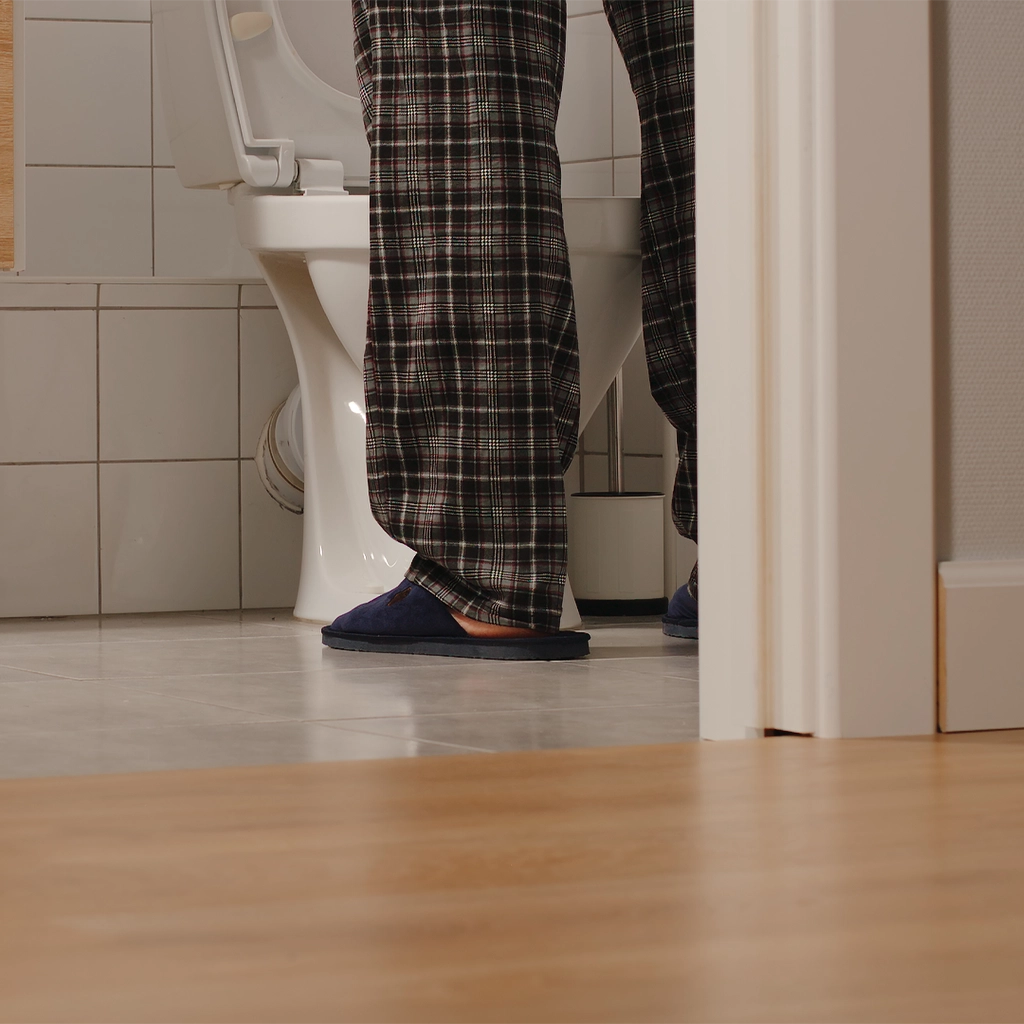
Changes in urination habits? It could be an enlarged prostate (BPH)!
Medically reviewed by Jeffrey Conaway, MD
Let’s start with a short self-assessment.
- Are you male?
- Do you struggle to start urinating?
- Do you notice a weak stream?
- Do you feel like your bladder never fully empties?
If you answered yes to the following questions, read on to learn more about what may be causing it (hint: these are all symptoms of an enlarged prostate)!
What is BPH?
The prostate gland sits just below the bladder and surrounds the urethra (the tube that carries urine out of the body). As men age, the prostate naturally grows. For some men, that growth is minimal and causes no trouble. For others, the prostate enlarges enough to squeeze the urethra and disrupt normal urinary flow.
BPH is extremely common. So much so that:
- About 50% of men by age 60 have some degree of prostate enlargement
- Up to 90% of men by age 85 experience BPH symptoms1
What are common BPH symptoms?
Many men don’t realize their symptoms are related to BPH because they develop gradually over time.
Common enlarged prostate symptoms include:2
- Weak urine stream
- Trouble starting urination
- Feeling like your bladder never fully empties
- Waking up multiple times to pee
- Sudden urgency to urinate
- Dribbling after urination
These are some of the most common searches by men:
- “Frequent urination in men over 50”
- “Weak urine stream causes.”
- “Why do I always feel like I have to pee?”
If these symptoms sound familiar, it may be time to get evaluated for BPH.
What are my BPH treatment options?
The good news is that BPH treatment options have expanded considerably, and what works best really depends on how severe your symptoms are and how much they’re affecting your life.
Mild BPH treatment options
For mild symptoms, lifestyle changes can make a real difference, such as:
- Cutting back on fluids in the evening
- Limiting caffeine and alcohol
- Doing pelvic floor exercises
When lifestyle adjustments aren’t enough, medications are usually the next step. Alpha-blockers (like tamsulosin) relax the smooth muscle around the prostate and bladder neck, improving urine flow quickly. 5-alpha reductase inhibitors (like finasteride) work differently- they actually shrink the prostate over time, though they take several months to show results. Some men do well on a combination of both.3
Minimally invasive BPH treatment
For many men, the idea of traditional prostate surgery can feel intimidating. Concerns about downtime, side effects, hospital stays, and recovery often cause men to put off getting treatment altogether. That’s one of the reasons more men are now turning to Prostate Artery Embolization (PAE) as a modern, minimally invasive option for enlarged prostate symptoms.
Men often choose PAE because it offers:
- No major surgery- no cuts or stitches, men leave with just a band-aid!
- No hospital stay- all patients come to our comfortable, outpatient center
- Lower risk of complications
- Faster recovery compared to traditional surgery
- Symptom relief without removing the prostate
Find relief from BPH symptoms like changes in urination habits at Clarity Care
If frequent urination, weak urine flow, or nighttime bathroom trips are disrupting your life, you do not have to simply live with it.
Clarity Care offers minimally invasive treatment options for enlarged prostate symptoms, including Prostate Artery Embolization (PAE).
Take the next step by having a conversation with our prostate specialists to see if you’re a candidate. Call us at 913.430.9940 to schedule.
Sources
- National Institute of Diabetes and Digestive and Kidney Diseases. Prostate Enlargement (Benign Prostatic Hyperplasia). U.S. Department of Health and Human Services.
- Urology Care Foundation. What Is Benign Prostatic Hyperplasia (BPH)? American Urological Association.
- McVary, K.T., et al. (2011). Update on AUA guideline on the management of benign prostatic hyperplasia. Journal of Urology, 185(5), 1793–1803.